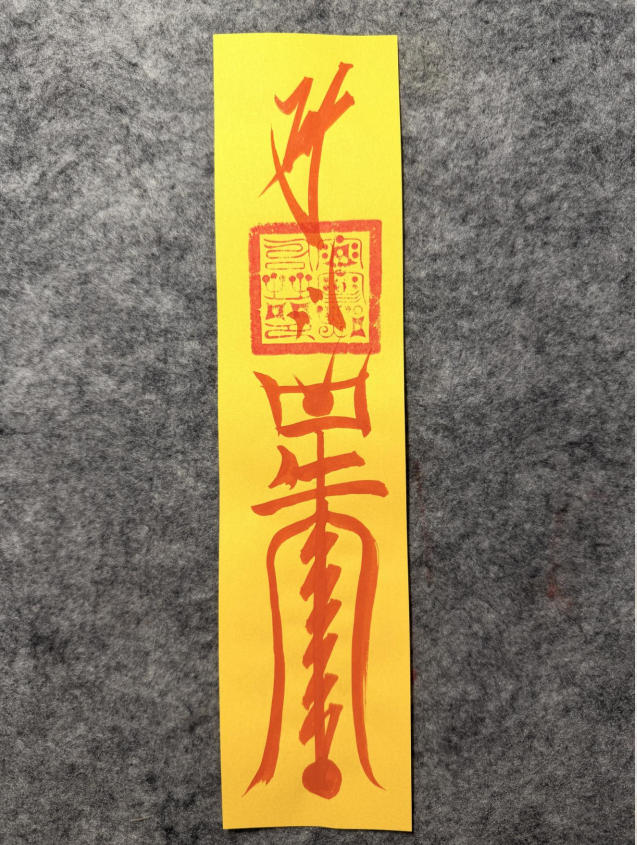
Thunder is one of nature’s most immediate images: a flash, a sound, a sudden shift in the air. In Daoist ritual and artistic language, it has often offered a way to think about movement, wakefulness, and decisive change. Its symbolism is not a single fixed code. Instead, it connects many strands of cosmology, ceremony, story, and visual expression.
Making an invisible force visible
Artists face an interesting problem when working with an image like thunder. The subject cannot be held still. A painting might show a cloud, a bolt, or a deity associated with storms; calligraphy can suggest it through speed, pressure, interruption, and turn. A sharp angle can feel unlike a slow curve. A sudden dense mark can create a visual jolt. These choices let brushwork carry an idea of energy without having to illustrate a weather event literally.
Traditional talisman writing has its own compact vocabulary of lines, characters, seals, and spatial relationships. To contemporary viewers, these elements may look abstract at first. Looking longer changes the experience: a composition has direction; the empty paper around a mark has weight; red ink draws the eye toward a decisive point. The work asks for attention at more than one speed.
Clarity, renewal, and the threshold
Across many traditions, thunder is associated with a break in stillness. In Daoist contexts, it can evoke clearing, transformation, and the force that interrupts what has become stuck. That makes it a compelling image for a hand-drawn artwork: every brushstroke begins in a moment and cannot be repeated in precisely the same way. The trace left on paper records a small act of decision.
The cinnabar-inspired palette common in talismanic art intensifies this effect. Against yellow or pale paper, a red line becomes immediate and alive. The contrast is visual before it is verbal. It helps explain why these works can be appreciated as calligraphy even by visitors who are still learning the cultural references.
Looking with patience
For readers new to Daoist visual culture, thunder symbolism offers a useful invitation: notice the qualities rather than trying to decode every mark at once. Is the composition quiet or forceful? Where does the eye pause? How does the brush move from one area to another? These questions turn a symbol into an encounter with material, motion, and human making.
At Xuanzhen Ge, we frame hand-drawn talisman calligraphy as cultural artwork made to order. Learning the stories around it deepens the experience, but no single interpretation is required. A powerful image can remain open—like a sound that arrives before the sky is fully understood.