Look closely at a Taoist talisman, or fu (符), and a question soon follows: what do those marks actually say?
Some look like Chinese characters. Others overlap, curl, or stretch into unfamiliar shapes. A fu may combine readable words, specialized writing, seals, and graphic forms. It cannot always be translated line by line like an ordinary letter.
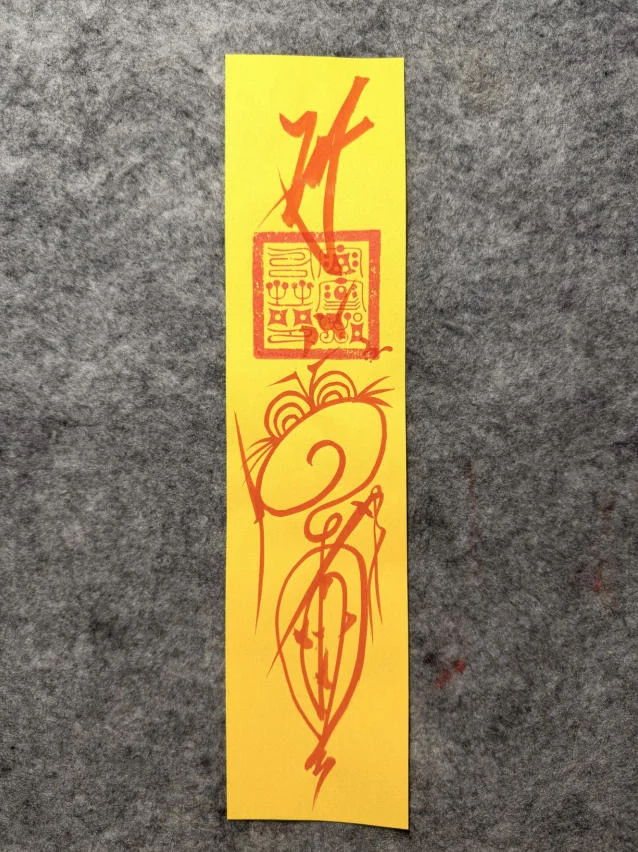
Full view of a Zhong Kui-themed work from Xuanzhen Ge. Observe its composition; this is not a film prop or a universal template for every fu.
Where should you start looking?
When introducing our own work, we find it helpful to look from top to bottom: the head, body, and foot of the talisman. This is a viewing framework, not a universal template for every Daoist tradition.
At the top, notice the opening marks. Some forms include characters such as 敕令, conveying the idea of an authoritative command; others use symbols associated with deities or a particular tradition. The body may contain names, ritual wording, or closely combined forms. At the bottom, look at how the composition closes. Its ending is not simply the equivalent of an artist's signature.
Forms differ across purposes and lineages. That variety does not mean anything goes: a particular tradition may have its own established patterns and rules.
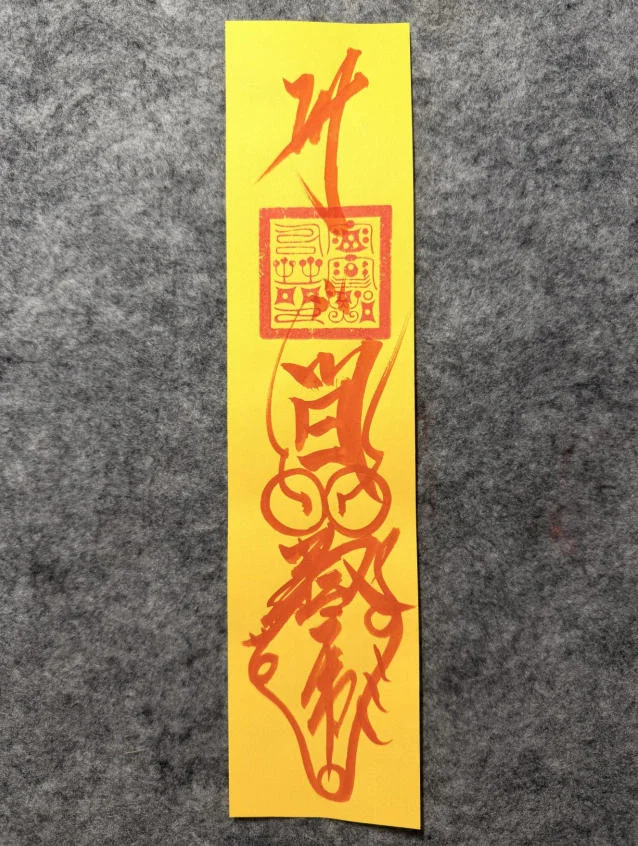
A Zhao Yuanshuai-themed work. Compare its marks and spacing with the Zhong Kui example; this is not a symbol-by-symbol translation.
Characters, special forms, and seals
Readable characters can offer a starting point. You may recognize a name or an individual word. Recognizing it does not establish the meaning of the whole talisman, and not every fu contains the same text.
Specialized forms may require knowledge beyond ordinary Chinese literacy. In the tradition described by our maker, some writings associated with divine names are explained through teaching within a lineage. Their meaning should not be guessed from appearance alone. Historical texts and scholarship also discuss talismanic writing; it would be misleading to dismiss every public explanation as speculation.
Seals occur on some talismans. They can relate to ritual identity or ideas of authority. A seal by itself, however, does not authenticate a lineage or demonstrate a promised result.
Graphic elements may draw on celestial, directional, or other symbolic imagery. Interpretation depends on the particular work and its context. There is no single decoding chart that explains every fu.
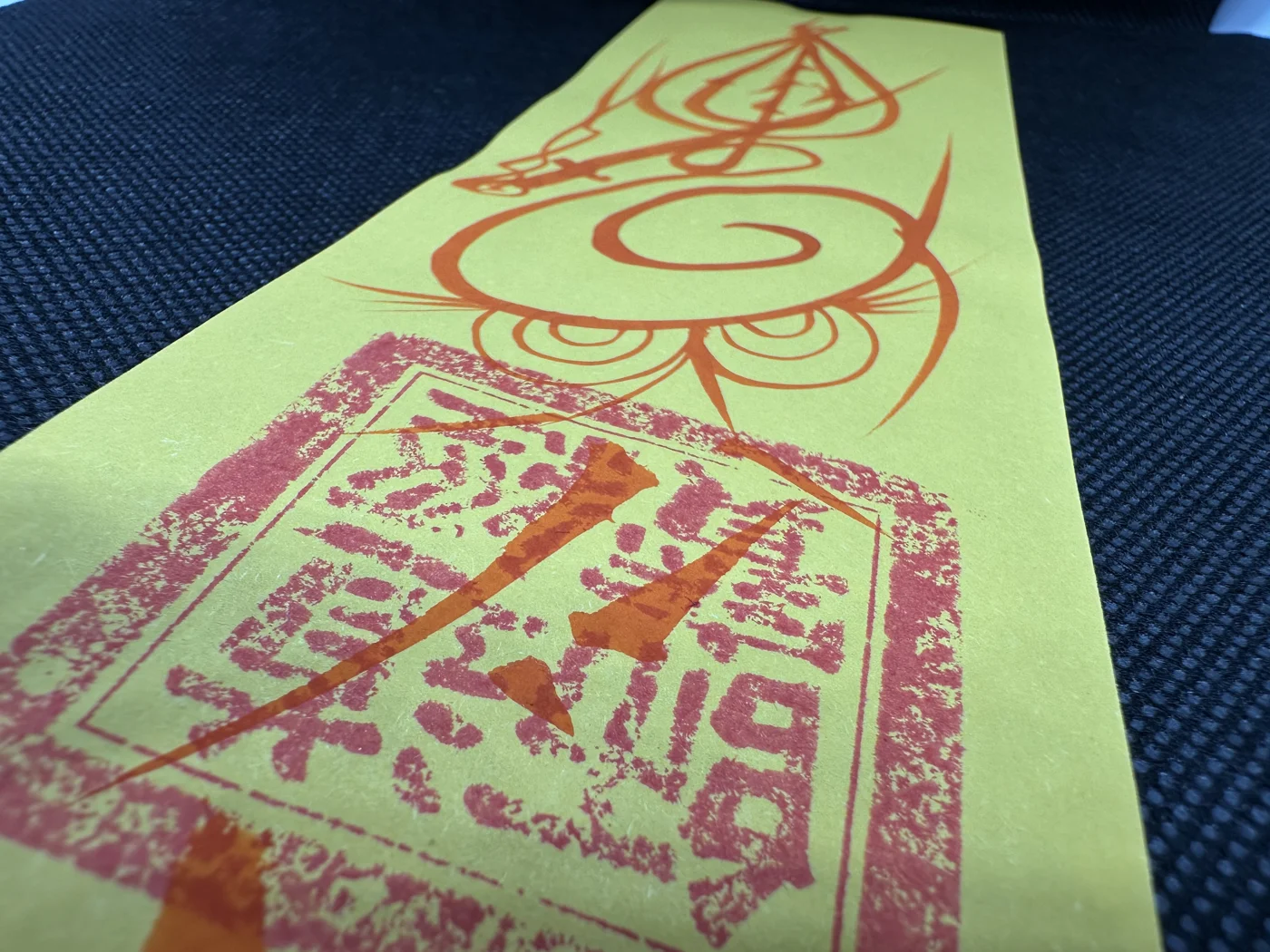
Close view of the Zhong Kui work: curved brush lines overlap a square seal impression, showing different edges and textures.
Why can Chinese readers find it difficult too?
Joined strokes, overlapping forms, and specialized symbols can be unfamiliar even to someone who reads Chinese. Talismanic writing is not always intended to communicate an ordinary sentence to a general reader.
Unfamiliarity does not make the marks random. Nor does it mean every stroke conceals a secret that can be translated word for word. Before looking for a translation, notice the spacing, changes of direction, and balance between dense marks and open paper.
A maker's view from Xuanzhen Ge
In our own practice, materials include yellow paper, a brush, and cinnabar or ink, depending on the work. We prepare a clean space, wash our hands, and settle our attention before writing. We aim for continuity in the brushwork and apply a seal according to our practice.
That continuity should not be mistaken for a rule that every talisman must be completed without ever lifting the brush. For us, the work brings calligraphy and ritual discipline together. It involves more than tracing an outline: movement, composition, and concentration matter too.
In a close photograph, you can see changes in line width and the texture of an impression against the paper. These are material details to appreciate, not independent proof of spiritual efficacy or lineage.
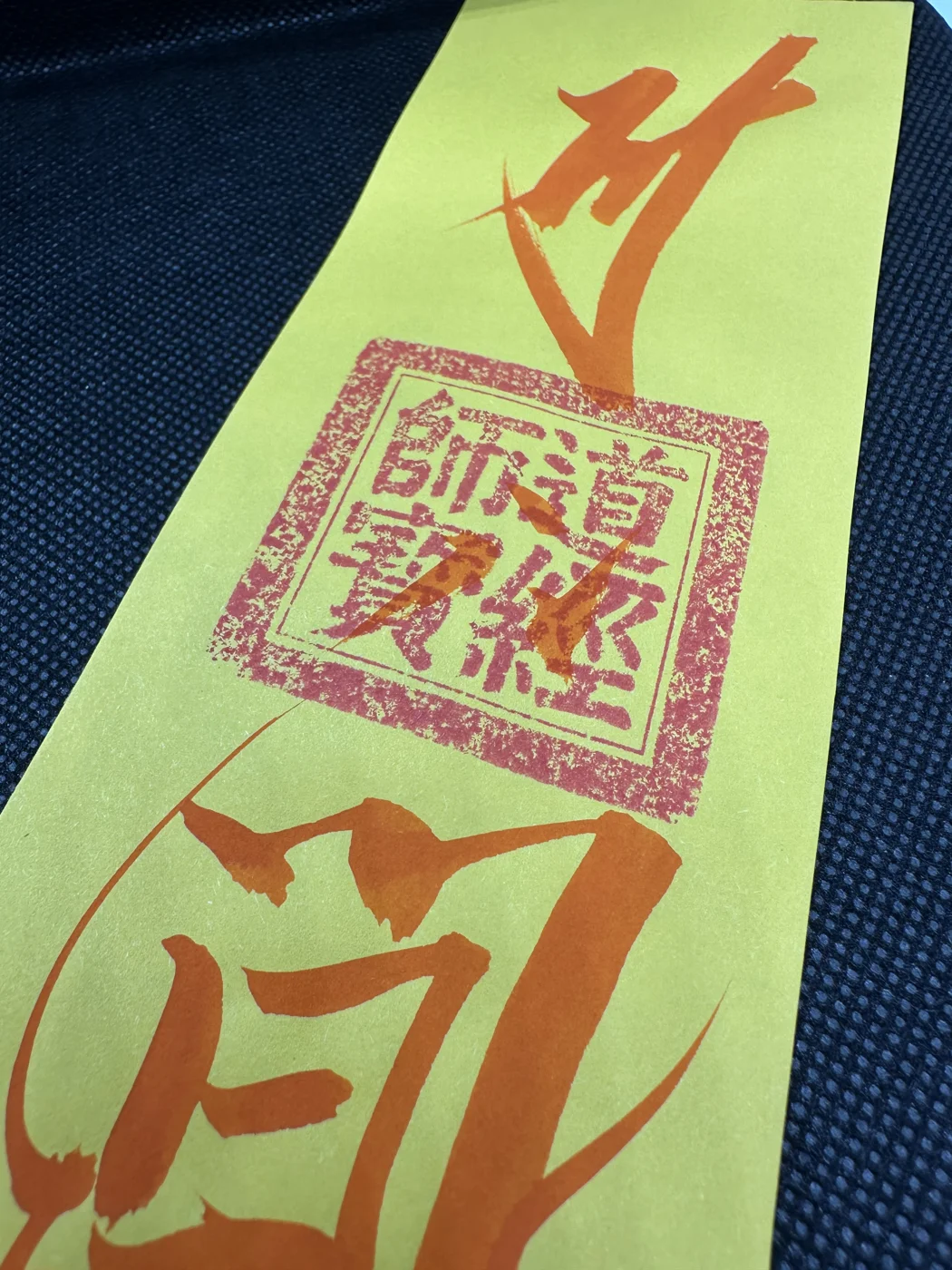
Detail of the Zhao Yuanshuai work: line width, the impression, and the paper surface. This photograph shows a finished work, not its making process.
What we leave unexplained
We do not offer a stroke-by-stroke decoding of material that belongs to private teaching in our own tradition. That is a boundary around what we share, not a verdict on everyone else's knowledge.
We also do not describe a talisman as a guarantee of wealth, health, or a particular outcome. Fu can carry religious meaning for practitioners and visual or cultural meaning for collectors. Those perspectives deserve to be represented accurately.
The next time you see a fu, begin with its arrangement. Recognize what you can, and take time with what you cannot. Understanding can start with looking, rather than decoding.