A strip of yellow paper. Red writing. A priest reaches forward, presses it onto a creature's forehead—and the chase stops.
If you have watched a Hong Kong jiangshi film, this image may be familiar. The paper talisman is commonly called a fu (符). Its screen appearance draws on Chinese religious and folk imagery, then turns that imagery into a dramatic prop. Understanding it begins with separating the cinematic effect from the physical object.
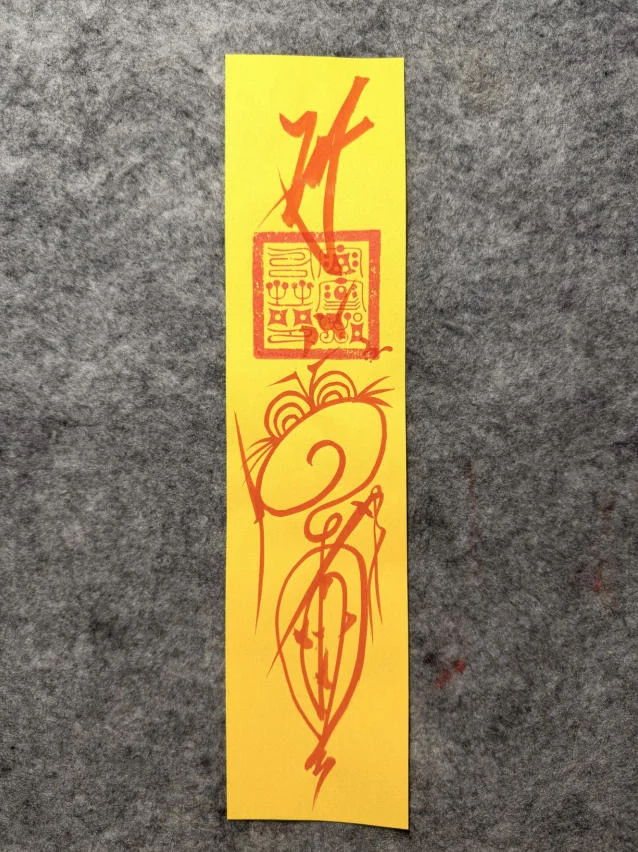
Full view of a Zhong Kui-themed work from Xuanzhen Ge. Observe its composition; this is not a film prop or a universal template for every fu.
Why yellow paper and red writing?
The combination is easy to recognize on screen. Fu outside cinema can also use yellow paper and cinnabar or other writing materials, but colors, pigments, and methods vary. Color alone cannot identify a lineage or establish authenticity.
In a film, strong contrast helps an audience notice a small prop. Close up, a real object offers different details: the surface of the paper, changes in the brush line, and the texture of an impression.
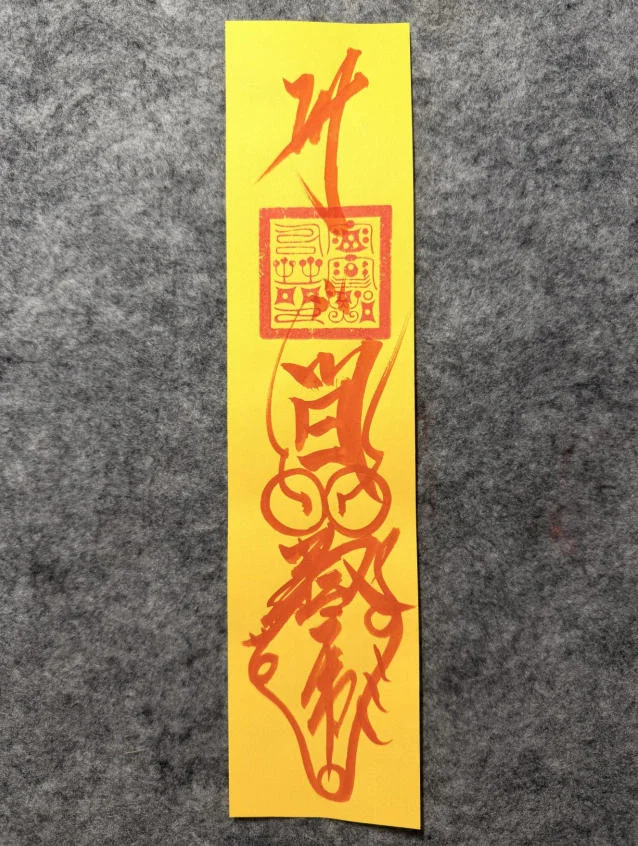
A Zhao Yuanshuai-themed work. Compare its marks and spacing with the Zhong Kui example; this is not a symbol-by-symbol translation.
How did the image become so memorable?
Mr. Vampire (1985) is a useful starting point. The Hong Kong Film Archive describes its success as sparking a wave of vampire films and discusses the genre as a creative combination of folklore and cinematic influences. Lam Ching-ying's priest is central to the film's story. Source: Hong Kong Film Archive
Within such a story, a talisman becomes a clear dramatic device. Is it still attached? Will it fall off? A small piece of paper can change the tension of a scene and support action or comedy.
That does not establish that cinema invented every element of the motif. The familiar forehead-talisman scene is best treated as a screen convention, not as instructions for a real Daoist ritual.
What belongs to special effects?
Talismans that fly toward a target, flash with light, or explode belong to a film's fantasy. They are not features a buyer should expect from a physical paper work.
The same distinction applies to an incantation that instantly resolves a scene. Even when a film borrows ritual language, its dialogue and timing do not represent every tradition that uses such language.
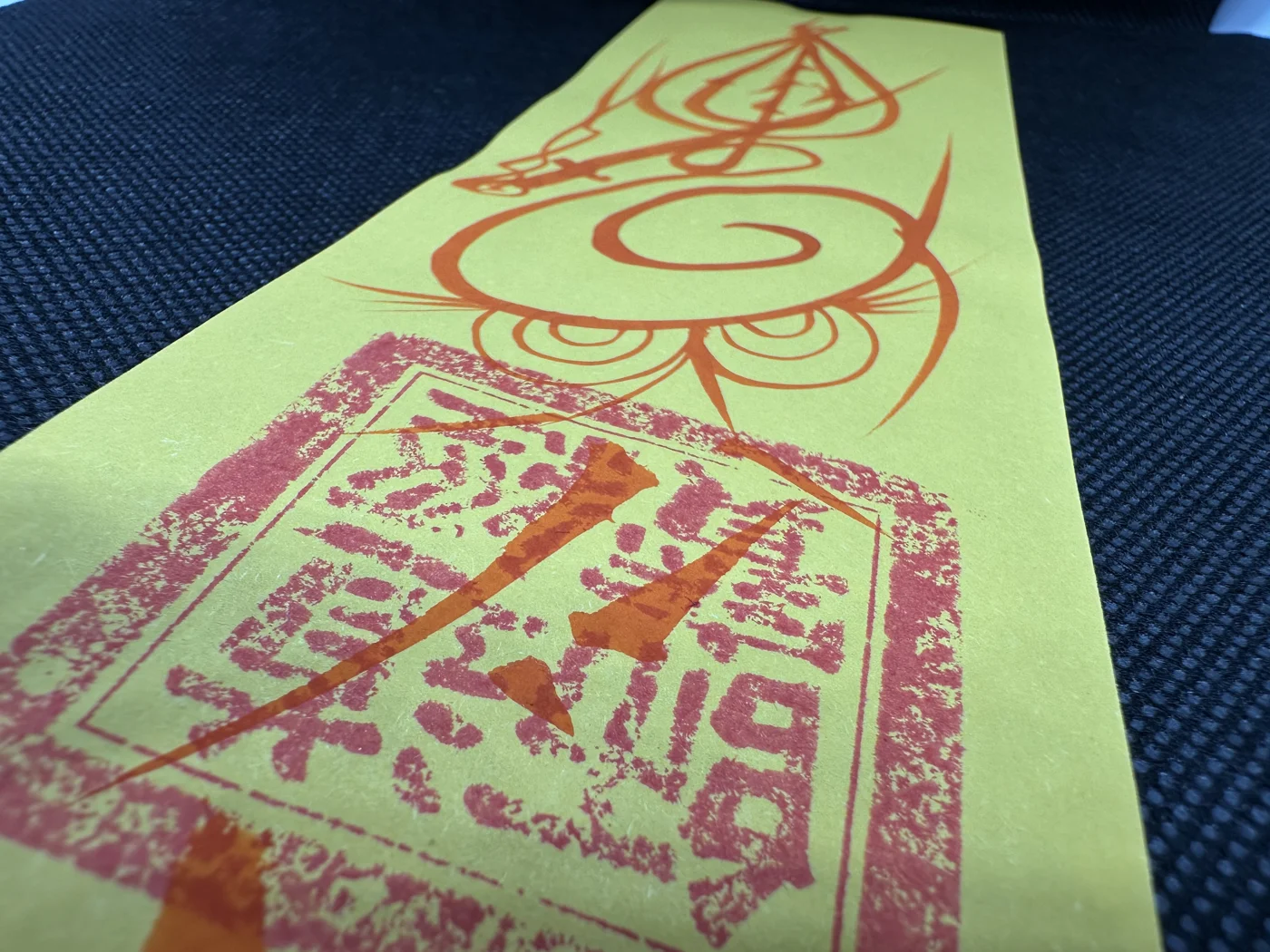
Close view of the Zhong Kui work: curved brush lines overlap a square seal impression, showing different edges and textures.
What does a fu mean outside cinema?
Fu can form part of religious and folk practices associated with blessings and protection. For practitioners, they may have serious religious significance. Other people approach them through calligraphy, visual culture, or collecting. Neither perspective needs to erase the other.
At Xuanzhen Ge, our maker emphasizes materials, a clean working space, focused brushwork, and the rules followed in our own practice. This is an account of how we work, not a universal description of every lineage. A photograph alone cannot verify a maker's ritual practice.
Screen references to “talisman water” also require care. We do not present burning talismans, swallowing ash, or drinking mixtures as ways to try the tradition or treat illness.
Cinema and the physical object
| On screen | When looking at a real work |
|---|---|
| Yellow paper and red writing immediately signal a talisman | Materials and forms vary; color is not proof of authenticity |
| A talisman flies, glows, or explodes | These are cinematic effects, not product features |
| A forehead talisman instantly stops a jiangshi | A familiar film device is not a real-world ritual guide |
| One line of dialogue solves the problem | Ritual context cannot be reduced to a catchphrase |
| Making the talisman takes only a brief shot | Ask the maker about the actual materials and process |
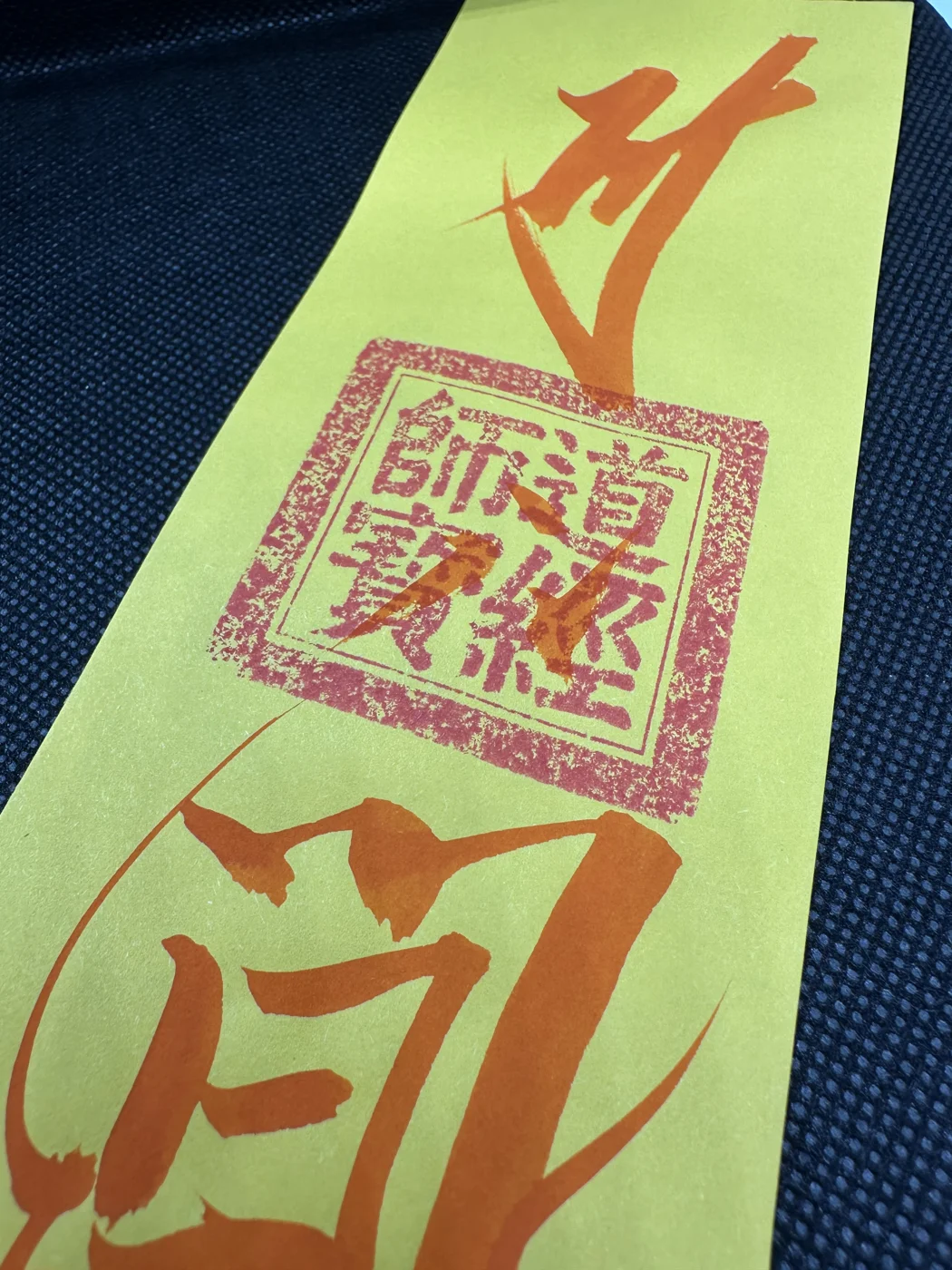
Detail of the Zhao Yuanshuai work: line width, the impression, and the paper surface. This photograph shows a finished work, not its making process.
From curiosity to a closer look
If a movie brought you here, you do not have to accept or reject every legend at once. Start with a real object. What marks can you recognize? Where is the seal impression? How does the brushwork change across the paper?
The photographs in this article show Zhong Kui- and Zhao Yuanshuai-themed works from Xuanzhen Ge. Neither is a prop from Mr. Vampire or a reproduction of its jiangshi talisman. The photographs offer a way to move from a screen image toward a particular work, its materials, and its story.
Enjoy the magic when the movie is playing. When you return to the paper, leave room for its own cultural context too.